|
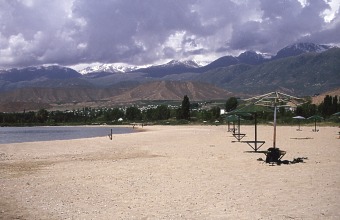
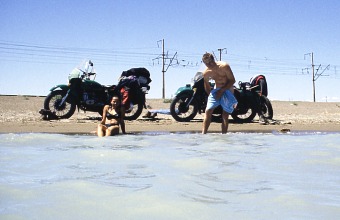
Issyk-kul is a lake the Kirghizstanis are more than proud of. One of the eternal truths about it is that the lake never goes to sleep under a clear sky. Every evening, clouds form over it, creating a beautiful sunset. The mountains around the lake have snowcaps and overall it is magnificent. Alongside the eternal truths there is one more firmly rooted in the minds of the Kirghizstanis and it is grey and heavy. The Russians chose this lake as a resort area for the slightly more prosperous and this led to development around the beaches. What's so bad about that? The money ran out awhile back, investors began to look the other way and most of the mega buildings in the Russian style have remained unfinished and deteriorating, alongside those that were completed. They had everything. Unique nature, beautiful beaches sown with parasols, lifeguard towers, (we passed a grand night on one of these), children's facilities and crystal clear mildly salty water. Today it's rusty iron and grey concrete. With heads full of questions and accusations we head off to Biskek.
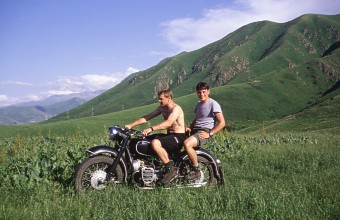
Upon our arrival Vovka pleasantly surprised us. The motorcycles were green as pond scum but otherwise super. We spent the next several days going around motorcycle bazaars and looking for keys, canisters for gas and water, new batteries, oil, spare plugs, tape, fire extinguishers, goggles, old helmets and leather jackets. This was exactly the way to get home without any big problems. Dress like poor Kerghizstanis and ride dirty on dirty bikes along dirty roads and blend in perfectly.
When we got everything together, it was time to leave. We said our goodbyes to Biskek and took off towards the Kazakhstan border. We barely rode twenty kilometers when I began to wonder how we could ever have been so naive as to think that we would ride over 6000 kilometers on these ancient Russian bikes. The motorcycles weren't happy, the motors and wheels smoked and I was experiencing a lifetime disappointment. Fortunately our friend Sasa, with whom we'd put these motorcycles together, was accompanying us for the start off. We stopped and he walked around the motorcycle, loosened all the brakes and pronounced a historic sentence. "You don't need to brake, you need to get home". We had long hours of riding across the steppes to think over the wisdom of this sentence, where we truly didn't need the brakes. At the border we said goodbye to Sasa and set off into the unknown.
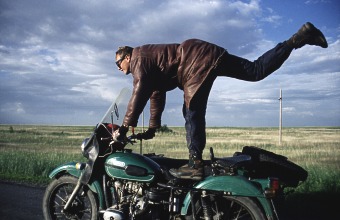
The word steppe becomes meaningful when after many years a person learns to live in it. We took a crash course. And the motorcycles were to be our learning aid. We could have started a notebook for a list of problems and repairs. Only thus could we have remembered in the peace of our homes all of them. We didn't, however, have a notebook. We only had Vovka's auto atlas, which was a relic from a time when not even my parents knew of each other. And had they known of each other and could have looked into the future at their son sitting astride a motorcycle with his girlfriend and accompanied by his friend in the steppes, they probably would rather have broken up. The dirt and dust which had followed us throughout our journey, had after the first few kilometers embedded itself irremovably into our jackets, pants, shoes and gloves, and this to the extreme that we blended into the steppes so well that when we reached Karaganda, no one would ever have guessed we were foreigners. In fact, we had become to them precisely those of whom we ourselves had been afraid. We became bandits who rob honest travellers. Today it seems to me that we disrupted the natural balance of things. It was as if the wolf had gone to see what the sheep were eating for dinner and then just went back in peace.
|
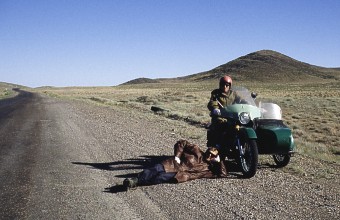
It was just at Karagand, about 1300 km from Biskek, that we needed to stop and get some spare parts, as my transmission was making blaring noises in low gear and Libor's Ural we had to teach to ignite fuel in the right proportions. We had reached the conclusion that it was not a fault of the teaching, but of the material. We searched so intensely that we finally found them. We added them to Libor's sidecar, from whose contents we could have built another entire motorcycle, knowing that nothing could surprise us anymore. Other days turned out differently though.
We couldn't complain about the weather in Kazakhstan. Only occasionally high, beautiful clouds appeared, but brought no front that would disturb the warm weather and mild wind. On the other hand, extremely hungry mosquitoes caused us no end of worry. Unthinkingly and forcefully they attacked any part of the body that wasn't covered in at least two layers. And one day I awoke to the sight of a strange old man, in whom I recognized Libor's features and also was able to sleep next to a half-Asian. This was when a mosquito bit Blanka's eyelid. I couldn't see my own face and so thought I was doing quite well.
Worse than the mosquitoes for us were the big and slow trucks that we had to pass. As you near one, all you see is a cloud of dust. When you're closer, you get a good whiff of black exhaust as well. You remember the Czech, "Ropak" creature, but everything goes out of your head when the truck sways toward you, and you're not certain if the driver has been drinking, or is just avoiding potholes you can't see. "Thud thud", that was two potholes, have to pass quickly before we hit others and it rips the sidecar off. I admire Blanka who must sit in it and watch the big wheels bouncing in rhythm with the Kazakhstan roads. "So Now!", in a cloud of smoke and dust for a short while the space before you opens up and there's nothing there. You put in throw in third gear, speed up, the Ural hiccups a bit, and you ride out of the darkness behind the car next to it. "Thud THUD", more holes, Blanka holds on tighter and I believe if it were possible, she would push the truck out of the way with her foot.
Ahead you see more holes. You pull needles from the carburator, let the engine take what it wants, just as long as it moves. Fine, now just wait for Libor, until he makes it too and we can ride on. You give him a hand signal to show it's clear. He smoothly manoeuvres next to the truck, but cannot seem to pass it. You know one of his pistons misfires, the other doesn't want more gas, and you see more potholes ahead. Does Libor see them? You move in front of the truck and watch your rear-view mirror. Yes Libor has seen them also and moved back in behind the truck. You can almost hear his curses. In a little while he tries it again. It's hard to say how many times you have to do this and how many times there's an oncoming truck. Instead you think about how many more holes the motorcycle can take.
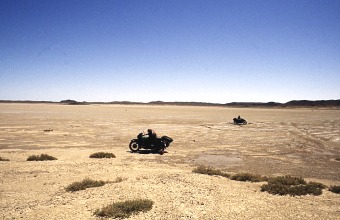
In the evening you then ride off somewhere far away from the road, take your aching and sweaty body off the motorcycle, start swatting mosquitoes and thinking what you're hungry for. From the cracked gas tank you pour some gasoline into the cooker and then find out that you don't have as much water as you thought. You can at least light a cigarette. The only woman near and far is fortunately with us and is fixing us food. Not that this should be a rule, but mostly it's been this way. Whether it was spaghetti, mashed potatoes, rice or soup, spices and garlic always made it into a feast for the shrunken stomach. Then one more cigarette and to sleep. Us to sleep and the mosquitoes to work. Drain to the bone. In the name of maintaining the species, regardless of losses.
|
