Cross country flights and competitions (Second part)
Now that we have "visited the neighbourhood", it is time to widen our horizons and start to make more challenging flights. I use the term "challenging" and not "long" because, even if the opinion of many pilots is that "the longer the flight is, the nicer" (the cross country records refer always to this theme), sometimes, though, it is more fascinating to deal with a flight with limited kilometres, but with major technical difficulties. In this last case, you will have to concentrate the flight in the hours with maximum thermal activities, for 3 or 4 in the afternoon in the spring - summer time. A pilot with a little bit of experience will be able to valuate with discreet precision, before the launch, which conditions he will find during the flight by simply looking in the sky (if you are interested to improve your skills on this matter you can consult some good books on meteorology).
However, once you took off and while you are in the first thermal, you should try to understand which might be the average values of the lift, at least of the first ones which you will meet during the route you have chosen. Note that the value of the thermal you are in at that moment is already a very good indication. If there are, we also need to observe the scattered cumulus which are on the route, or eventually observe the other pilots which are in front of us in order to have a better idea of what will be the quality and quantity of the lifts at our disposal. Doing this, we can decide what speed we need to maintain in our next glidings. The stronger the thermals are, the faster will be our glide speed. Only at indication level we can say that for a last generation topless hang glider, it is very rare that we fly less than 55-60km/h between thermals. In the days where the medium value of a lift is of 2.5m/s it's often to fly around the 65km/h. For a lift of 4m/s it's get at ±75km/h. In stronger thermals it's possible to reach even 80-85km/h.
These values need to be taken with caution, see that they depend of many other factors. Some of them are: the type of wing, weight charged on the wing, the direction and the intensity of the wind and last but not least the quote at your disposal (as strong as the next thermal might be, you need to reach it before putting your feet on the ground). Therefore when you decided which medium speed you need to maintain, you now only need to search for the best route in order to lose as less quote as possible. Also here, the capacity of interpretation of the cumulus and the morphology of the ground, is of big importance and surely depends more on the pilot's experience than on the theoretical preparation.
|
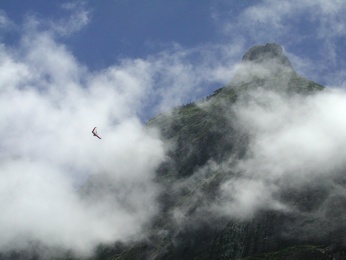
It is not always easy, though, to decide whether to follow a "street" with cumulus which forces us to a route deviation. Generally speaking, it is better to stay above the supporting line even if this way you fly a few superfluous kilometres. In fact, in this case you are sure to reach the next thermal, or you can fly faster if you only need to reach the landing place. This choice becomes "compulsory" if you are flying with side wind and when our "street" of cumulus is windward to our theoretical direction.
I think that in this kind of flight (not too long, but difficult and very intense) is a gratification for everyone, not only aiming on the accomplishment of the flight, but also try to bring it to an end in the less time as possible. This exercise, which seems to appear finalized exclusively to the speed and only reason for a competition pilot, is very useful to learn about the weather conditions, with its different earth morphologies and also to learn about our wing. In other word, it helps you to feel safer in flight, and it also helps you to understand that the glide efficiency does not only depend from the air but also from the flight path that we make (the fastest distance in flight between 2 points is not always a straight line).
Furthermore, this exercise will help you to take quick decisions, which otherwise are always delayed till the thermal finishes. Thanks to this exercise, also the capacity of valuating the atmospheric changes and their speed will be positively influenced.
|
